
A quick note before anything else: testosterone replacement therapy is a prescription treatment for diagnosed hypogonadism, and where compounded testosterone is involved, those products are not FDA-approved finished drug products. The percentages below come from trial populations, not from your bloodwork. A clinician who has actually seen your labs is the one who should weigh them against your own risk.
Here is the question most men actually want answered before they read anything else: does this stuff hurt your heart? For a long time nobody could say for certain, which is exactly why so much of the conversation around testosterone therapy has felt like a debate between two extremes, one side treating it as risk-free, the other treating it as a heart attack waiting to happen. Neither extreme survives contact with the largest trial ever built to test it.
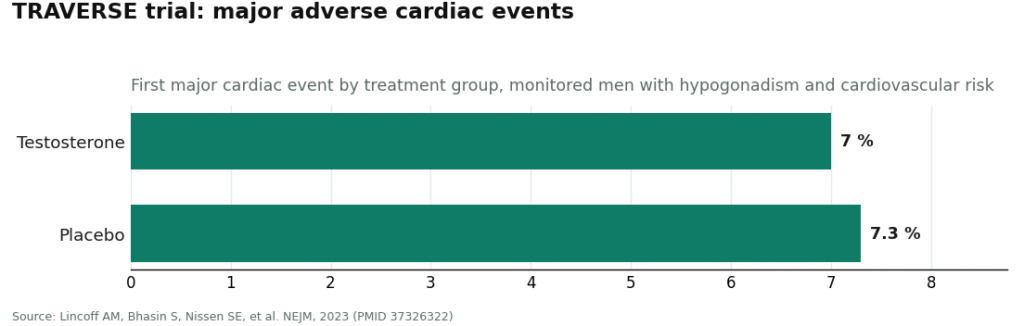
That trial found a first major cardiac event in 7.0 percent of the men on testosterone and 7.3 percent of the men on placebo [1]. Two numbers, three-tenths of a point apart. That is the anchor for everything else in this piece, and it is worth sitting with before moving on, because almost every other worry a man brings to this decision branches off from it.
The worry: “but what about my heart?”
The trial behind those two numbers is called TRAVERSE, published in the New England Journal of Medicine in 2023. It was designed for exactly this question, and it did not use a low-risk sample to get there. It enrolled 5,246 men, ages 45 to 80, all with diagnosed hypogonadism, and all either already living with cardiovascular disease or sitting at high risk for it [1]. That is the population doctors have worried about most for decades, and testosterone came out noninferior to placebo on the primary measure, first major adverse cardiac event, 7.0 percent versus 7.3 percent [1].
That is genuinely reassuring, and it deserves to be said plainly rather than buried under caveats. But the same trial did not stop at the primary endpoint, and neither should the answer to this worry. TRAVERSE also found higher rates of atrial fibrillation, of acute kidney injury, and of pulmonary embolism in the men taking testosterone [1]. None of those three numbers overturns the main finding. None of them means testosterone should be withheld from a man who needs it. What they do mean is that “heart-safe, full stop” is an overstatement, and so is “it wrecks your heart.” The accurate sentence sits in the middle: no increase in major cardiac events among monitored men, alongside a specific, named list of secondary risks that monitoring exists to catch.
The worry: “what am I actually supposed to get monitored for?”
If the heart question gets answered by one trial, this next one gets answered by a checklist, the one in the Endocrine Society’s 2018 clinical practice guideline [2]. Three things sit on it every single time: repeat testosterone levels, hematocrit, and a prostate-risk evaluation [2]. Two of those deserve a slower look, because they are the risks a man is actually likely to encounter along the way.
Hematocrit. This is the percentage of your blood made up of red blood cells, and testosterone stimulates the body to make more of them. That effect is dose-related, meaning the more testosterone in the picture, the more it tends to move. A complete blood count catches it early, and if the number climbs too high, the fix is usually a lower dose or a pause, not an emergency. The practical lesson here cuts against a very common instinct: chasing a higher testosterone number to feel a little better does not come free. It is one of the plainer arguments against “more must be better” that this whole topic offers.
Fertility. Exogenous testosterone suppresses your body’s own production, and a real, expected consequence is a drop in sperm count, sometimes a significant one. This is not a maybe. It is why the conversation about children, if that is anywhere in your future, needs to happen at the start rather than the middle. HCG and gonadorelin can help preserve testicular function during treatment, and SERMs such as enclomiphene or clomiphene can raise your own testosterone while protecting fertility. A provider that only stocks testosterone and nothing else cannot offer this part of the protocol, which is worth knowing before you pick one.
The worry: “does this cause prostate cancer?”
This is probably the oldest fear attached to testosterone therapy, and it is also the one the current evidence supports the least. The Endocrine Society guideline does not treat testosterone as an established cause of prostate cancer. What it does is build a prostate-risk evaluation into the standard monitoring plan [2], which is the posture of careful watching, not the posture of treating a known danger. The honest version of this answer is that prostate health gets tracked during therapy the way it should be tracked regardless, not that testosterone is quietly causing cancer. It stays on the list of things to monitor. It does not belong on the list of reasons to say no to treatment a man actually needs.
The worry: “will this finally fix my energy?”
Here is the one that flips the usual pattern, because it is not really a safety question at all, it is an expectations question, and it is where testosterone therapy tends to get oversold. The Testosterone Trials followed 790 men, 65 and older, with confirmed low testosterone, under placebo-controlled conditions, and found no significant improvement in vitality on a standard fatigue scale [3]. What did improve, clearly, was sexual activity, desire, and erectile function, along with a modest lift in mood [3]. So the honest expectation to walk in with is better sexual function and a mood bump if your levels are genuinely low, not a guaranteed fix for feeling tired all the time. That gap between the marketing and the trial data is worth knowing before you start, so you are not disappointed by a benefit that was never actually promised by the evidence.
The answer, laid out in one place
Read together, these worries resolve into a fairly simple pattern. The big cardiac fear did not hold up on the main measure, 7.0 versus 7.3 percent [1]. A short, specific set of secondary risks did show up, atrial fibrillation, kidney injury, blood clots in the lung, and those are exactly what supervision is built to watch [1]. Hematocrit rises in a dose-related way and gets caught by a routine blood test [2]. Fertility takes a real hit that can be managed with the right supporting medications [2]. The prostate gets monitored, not treated as a ticking clock [2]. And energy, the benefit most often promised, is the one the best trial available could not confirm [3]. Nearly every real risk on this list turns out to be a monitored, manageable one. The risk that is hardest to manage is the one nobody is watching for at all.
The path: what supervised monitoring looks like in practice
It helps to see this worked out somewhere real rather than left as an abstract principle. FormBlends runs a physician-supervised telehealth model: a licensed physician reviews the case, the testosterone is dispensed through a licensed 503A compounding pharmacy, and the standard monitoring panel, named on its testosterone-cypionate page, covers total and free testosterone, estradiol, hematocrit, PSA, and a lipid profile. Lined up against everything above, that panel is not arbitrary. Hematocrit covers the blood-thickening risk. PSA covers the prostate row. Estradiol and lipids round out the broader picture. It is named here as one clear example of monitoring done the way the guideline intends, not as an endorsement to purchase anything. The contrast worth holding onto is the one against a self-sourced vial with no labs attached, where every single row in this piece goes unmeasured.
Questions that tend to come up next
Does testosterone therapy raise the risk of a heart attack?
In the largest trial run on this question, no. TRAVERSE found testosterone noninferior to placebo for major adverse cardiac events, 7.0 percent against 7.3 percent, in men with low testosterone and real cardiovascular risk [1]. The same trial found higher rates of atrial fibrillation, acute kidney injury, and pulmonary embolism in the testosterone group, which is the actual reason ongoing supervision matters [1]. The fair summary: no increase in major cardiac events under monitoring, with a specific short list of secondary risks a clinician keeps an eye on.
What’s the side effect worth watching most closely?
A rise in hematocrit, the share of your blood taken up by red cells, driven by testosterone’s effect on red blood cell production. It moves with dose, it sits on the guideline’s first-year monitoring checklist, and it is caught with a routine complete blood count [2]. If it climbs too far, dose reduction or a pause usually brings it back down, which is exactly why dosing under supervision, rather than self-adjustment, is the safer route.
Does testosterone therapy cause prostate cancer?
The current monitoring-era evidence does not support that. The guideline calls for a prostate-risk evaluation as part of standard monitoring [2], which reflects caution rather than a confirmed cause-and-effect relationship. Prostate health gets watched during therapy. It is not, on the evidence available, a reason to withhold treatment from a man who needs it.
Will testosterone therapy actually give me more energy?
Not reliably, and that is a gap in benefit rather than a safety concern. The Testosterone Trials found no significant vitality improvement on a standard fatigue scale, alongside clear gains in sexual activity, desire, erectile function, and a modest mood improvement [3]. The realistic expectation for a man with genuinely low levels is better sexual function and mood, not a dependable energy boost.
Can testosterone therapy speed up hair loss?
It can, but mainly in men already carrying the genetic pattern for male-pattern baldness. Testosterone converts into dihydrotestosterone (DHT), the hormone responsible for shrinking hair follicles over time. If the men in your family tend to keep their hair, your risk stays low. If baldness runs in the family, therapy may move that timeline up, though it rarely starts hair loss in someone with no genetic tendency toward it at all.
What does testosterone therapy cost without insurance?
It depends heavily on delivery method and clinic model. Generic weekly injections tend to be the cheapest path, often $30 to $80 a month for the medication itself, while branded gels, pellets, and nasal formulations can push the total well past $200 to $500 a month once labs and follow-up visits are added in. Physician-supervised compounding pharmacies, FormBlends among them, can sometimes sit in a middle range while keeping the clinical oversight intact.
Will insurance cover testosterone therapy?
Often, yes, but usually only with documented low testosterone confirmed on at least two morning blood draws plus symptoms matching the plan’s criteria. Coverage tends to be far more consistent for diagnosed hypogonadism than for borderline, age-related decline. Even with coverage in place, certain delivery methods, pellets especially and some compounded formulations, are routinely excluded, so it is worth a call to the insurer before settling on a format.
Why does blood monitoring matter so much during testosterone therapy?
Because testosterone drives red blood cell production, which raises hematocrit, the share of blood made up of red cells. Push that too high and the blood thickens, which raises the risk of clotting. Most protocols draw the line around 52 to 54 percent and will pause or lower the dose if a man crosses it. This is the practical reason routine bloodwork is not optional on testosterone therapy. It is the mechanism that keeps the whole risk picture manageable.
References
- Lincoff AM, Bhasin S, Nissen SE, et al. Cardiovascular Safety of Testosterone-Replacement Therapy (TRAVERSE). New England Journal of Medicine, 2023. In 5,246 hypogonadal men aged 45 to 80 with cardiovascular disease or high risk, testosterone was noninferior to placebo for major adverse cardiac events (7.0 percent versus 7.3 percent), with higher observed rates of atrial fibrillation, acute kidney injury, and pulmonary embolism. https://pubmed.ncbi.nlm.nih.gov/37326322/
- Bhasin S, et al. Testosterone Therapy in Men With Hypogonadism: An Endocrine Society Clinical Practice Guideline. Journal of Clinical Endocrinology and Metabolism, 2018. Structured first-year monitoring includes repeat testosterone, hematocrit, and a prostate-cancer-risk evaluation; treatment is limited to men with symptoms and confirmed low testosterone. https://pubmed.ncbi.nlm.nih.gov/29562364/
- Snyder PJ, et al. Effects of Testosterone Treatment in Older Men (The Testosterone Trials). New England Journal of Medicine, 2016. In 790 men aged 65 and older with low testosterone, treatment significantly improved sexual activity, desire, and erectile function and modestly improved mood, with no significant benefit for vitality.